The second week of my curriculum focused on guard passing. For me this is the most important part of grappling, there’s really nothing harder. If I want my students to develop a good guard then they have to have a partner who understands guard passing, however to have students pass guard they don’t necessarily need to have a partner who understands how to play an effective guard. This is where context is king. If we are teaching a basic technique without the grapplers having context then they will never be able to apply this technique in a live roll against an active opponent.
The goal of my classes is always for the students to get a two for one. Meaning, as I’m teaching guard passing they should be learning something about guard retention. We start with the very basics. These two practices should be 60 minutes of action with 15 minutes of explanation. With the goal being that the explanation time gets reduced greatly by week 3 or 4.
Monday: Class on Monday always begins with the 4 line drills, forward rolls, backward rolls, granny rolls, sidewinders. Then progresses into the focus of the day:
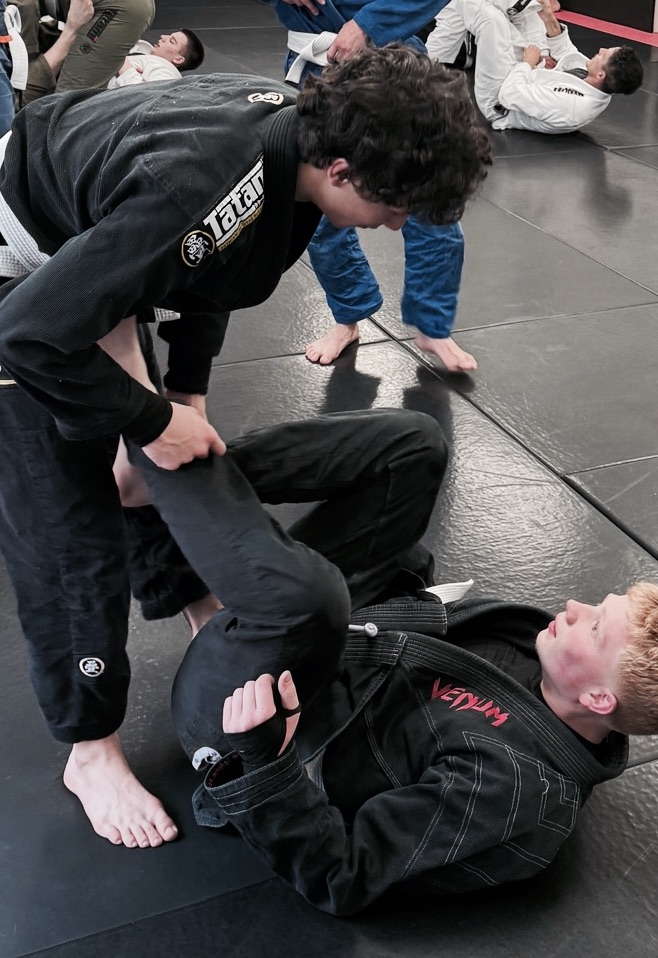
The start of guard passing. I started the practice by defining the terms. Keep things simple. Bottom players goal is to keep their thighs touching their chest, ultimately this is what defines a guard. If my partners thighs are on their chest then I haven’t passed their guard. It’s really as simple as that. Top person tries to remove the thighs from the chest and replace it with his or her own chest. That really is the whole of the explanation. This game has a winning criteria for the top player but it is a continuous drill for the guard player. Today I split my class into groups of 4 students. This pod work is the main structure of my practice. I ran this game for 3 minutes per active grappler (guard passer), with 10 seconds of rest. The top player stays in for the entire 3 minutes and when they complete their task (getting chest to chest) then the drill resets with a new guard player. Top player does this over and over until the time runs out. This means that top player may never actually complete the task. That’s ok. Failure is an important part of the process. We want to avoid false positives at all costs. So its ok to not win. Today I found that almost everyone in the group was able to get chest to chest at least once during their time. Then we move on to person 2, who then spends 3 minutes attempting to get chest to chest. Then person 3,4 until the round ends.
My job as a coach is to be watching the students as they work through the problem. I’ll look to identify specific trends and habits. Then I’ll bring the group together to discuss the first round of games. Feedback tends to be slow, students have a hard time expressing their challenges in front of the class. That’s ok, I already know what they are struggling with. I briefly discussed separating knees from chest with ankle grips, moving through a Torreando style pass, without showing a technique. I really love this simple class, it allows for absolute beginners to play without overwhelming them with the technical aspects. It also allows for advanced students to play and improve.
The class then repeats the game, in the same pods of 4, this time with a few details from me. Primarily, the idea that bottom person needs only to continuously return their thighs to their chest. So any time top player is able to gain separation they must immediately fill that void. Now, with that added context the group seemed to have a much better grasp of the game. The rounds seemed more competitive and the pace went way up. The goal here is that my students feel confident enough to play the game at full speed. Often times new students are hesitant and scared to go for it, so they hold back. This tends to be mostly because they don’t have enough context to play the game without worrying about making mistakes.
Round two went really well, I saw technical guard passing, without the lengthy explanation that would have only confused them. We will eventually get into the technical aspect of these scenarios but for now I just let them play. In a few months they will have the context necessary to use the technical information, for now we play.
A really great thing happened tonight, the practice focused on guard passing but I think the real lesson was for the guard players, they improved so dramatically over the course of the practice. This will make my lessons on guard so much easier!

 The Superstition Club
Leave a comment