Now that my students have a bit of context I can begin to sprinkle in a few details. I don’t want to overwhelm them with technique, but I do want them to have a few ideas in their head as they begin to problem solve. It’s important that the students understand that concept. They have a goal. Get chest to chest with their opponent and fill the gap between bottom players thighs and chest. Everything the bottom player does to stop this is a new problem to solve. The techniques we typically learn are meant to be broken down into small problem solving segments, they are rarely meant to be done in succession without fail. We have three primary ways to get by the legs. We can go over, under or through. That’s the most simple way to break it down. I begin my pass attempt, bottom player moves to stop my pass, then I need to assess the new position and decide “over, under or through”. This continues on until I’ve completed the task.
The games today looked exactly the same as on Monday, there’s no need to change the objective for the top player, but to make things a little more difficult we talked about pulling the guard passer into our closed guard as a means of victory. So now bottom player has a way to end the rep. Bottom player can simply maintain their open guard for 3 minutes or they can close their guard to end the rep immediately. This makes things more difficult for the passer and also gives the game a more realistic approach. This also means the guard passing will funnel its way into more traditional looking techniques.
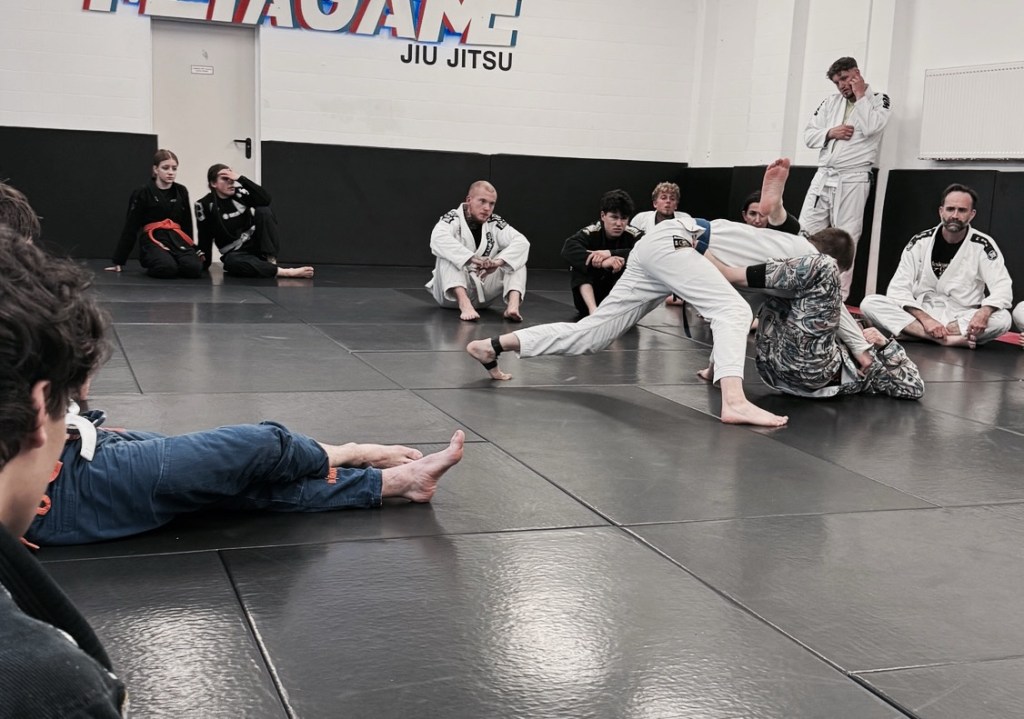
Game 1:
Groups of 4 students. Active player works to pass the guard and solidify chest to chest to end the rep. Bottom player maintains guard or closes their guard. Top player works for 3 minutes as bottom player rotates out when the rep ends.
Discussion: Lots of great improvements happening. At the beginning of each round I noticed lots of guards closing quickly. Then the lightbulb moment for the top player, they had to be a bit more careful in their approach. You can’t just barrel into a guard player or they will lock up their guard. The students seemed to acknowledge and solve that problem very quickly. Then the guard passing started to look more like traditional guard passing.
I talked about pressure passing, for me, the start of a guard pass can be quick. The goal being that our guard player over reacts to our movement. Similar to wrestling, we faint and pivot waiting for our opponent to make a harsh movement then we strike. The same can be said for guard passing. We use our movement to gain entry, but then the game grinds to a slow pace. Once we have a solid passing position we need to maintain pressure and work to progress downward to a chest to chest pin. We see this at the higher level as inside and outside camping.
In most Jiu Jitsu scenarios, the grappler in control wants to slow the pace, the grappler in a losing position wants to increase the pace, they want a scramble. Guard recoveries rarely happen at a slow pace, they almost always happen as the result of a scramble. The goal of the top player is to mitigate those scrambles.
Game 2:
No changes to the format of the game. 3 minutes of work time for the top player. Bottom player rotates out when the rep has ended.
Conclusion: Overall a great class. There is really nothing more rewarding as a coach than seeing absolute beginners start to do Jiu jitsu. To take them from knowing nothing to knowing just a little bit is such a sight to see. Watching a purple belt move to brown is great, but the learning curve at the beginning of Jiu jitsu is unparalleled. This is why I love teaching the beginners program so much. Next week we move on to guard retention. We’ll focus on maintaining a guard, not accepting a pass and using our guard to move to a standing position

 The Superstition Club
Leave a comment