Last night I wanted to build on the ideas from Monday, primarily in strengthening our ability to off balance our opponent. For 26 weeks we have talked about feet on the hips. For a beginner this is the safest place to keep our feet from the guard. If our feet are on our opponents hips, they cannot pass our guard, full stop. This doesn’t always mean we can create off balance from here and it doesn’t mean our opponent will not find ways for the feet on the hips to lose their function. So we need to learn to use our feet to actively solve the balance problem. Remember, everything we do from our guard breaks down to two actions.
1- we trap a post and push our opponent over that post
2- we make our opponent extend their limbs.
All guards break down to these two ideas.
Technique: Round one looks very similar to monday’s lesson. Starting with and maintaining collar sleeve grips, we will work to off balance our partner. The bottom player ends the rep by reversing positions and ending on top, or by crossing their ankles in a loose lock triangle.
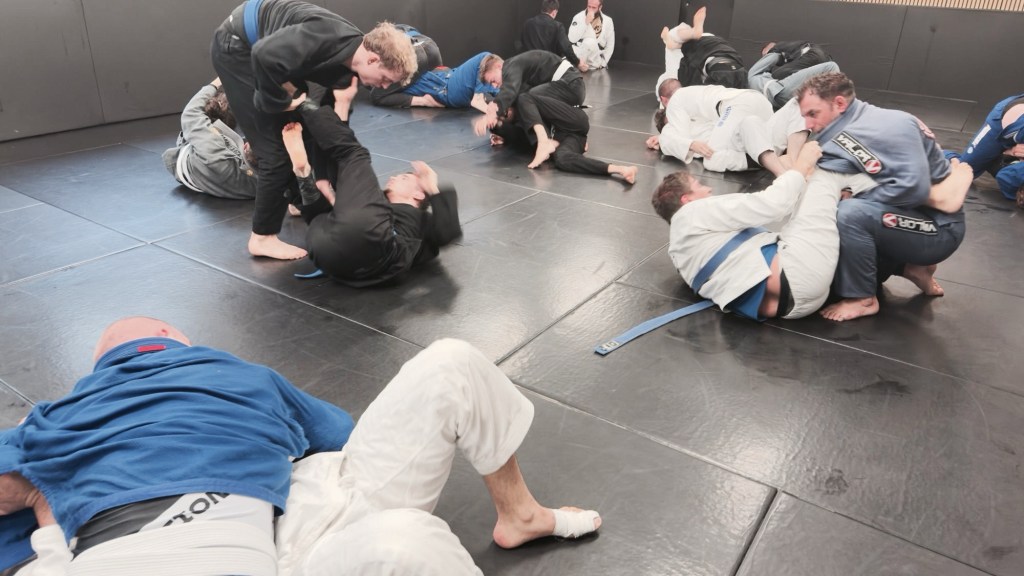
Discussion: Our feet do arguably more work from the guard than our arms do. In most cases our arms trap posts and anchor to our opponent. From here our legs create the drive necessary to off balance (sweep) or create extension (submission). As we develop our guard game we will learn a multitude of ways to use our legs, but as beginners I want the students to focus on three safe placements.
1- Feet on hips. This is home base. Any time our opponent begins a guard pass they must get past our feet. So as they progress through their guard pass we need to be actively returning our feet to their hips. Our feet on hips position works best in the midrange of elevation from our opponent.
2- Foot on knee. This is the best option when our opponent is very low in elevation. Sitting back on their heels and in the Gracie posture. From here feet on hips simply anchors our opponent to their heels, securing their position. When we transition our feet to their knee we are able to push them into a straight leg position.
3- Foot in armpit. This is the best option when our opponent is in an elevated position. From a standing pass or combat base (one foot up, one knee down).
Learning to use these three positions at the right time should greatly improve our off balancing.
Technique: This time we will work with a cooperative partner. Top player will move slowly through their range of postures, guard player will then experiment with pushing on the knees, hips and armpits to create off balance throughout a range of motion. Timing and accuracy are key here. Pick the wrong foot placement and you’ll anchor your partner to a stable position. Pick the wrong timing and you risk the top player making a pass opportunity.
Positional Sparring: Now lets turn this into a live game. Bottom player has three ways to win the game. 1) reverse positions and end on top. 2) Make the top player extend their limbs and force a hand to the mat. 3) Cross their ankles in a loose lock triangle.
1 minute work time, switch top and bottom. 6 rounds total.
Top player has one goal. Stand up. If they are able to move to a standing position without putting their hands on the mat they win.
Conclusion: I think this is a great way to learn active guard play. It’s amazing how many mid belts don’t understand this simple idea. They are so prone to force positions only to fail because they don’t understand the timing. On top of that they don’t understand why they grip the way the do or why they place their feet in certain places. They only know the rigid techniques they were taught, which are bound to fail when attempted at the wrong times. The core to any good guard game is absolutely our ability to off balance. If we can’t be successful in this we will always struggle with our guard.


Leave a Reply