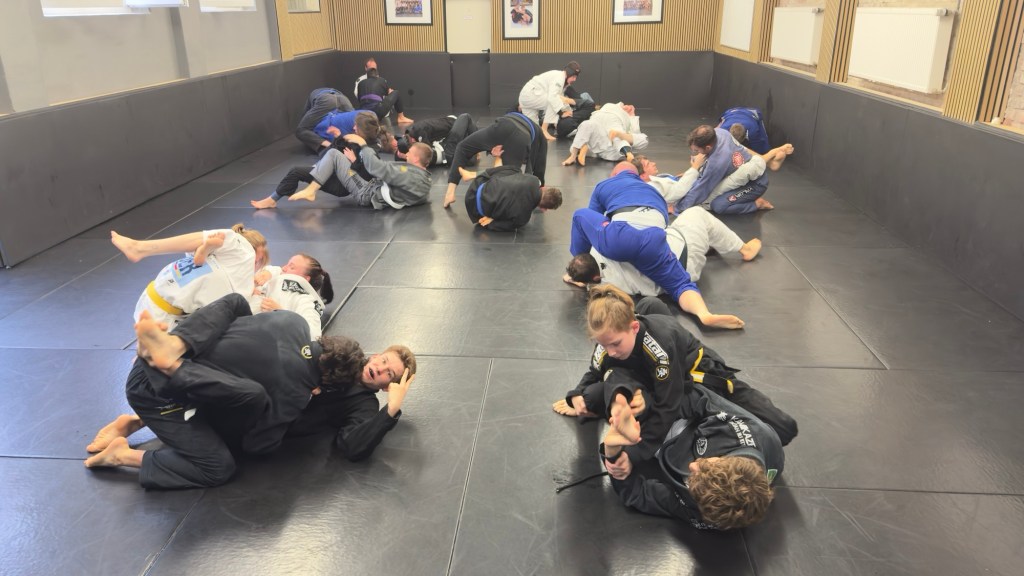
A week in sunny Croatia gave me lots of time to think about which direction I wanted the curriculum to move towards. Context is everything in Jiu jitsu. So the order in which we learn matters immensely. I want my white belts to master staying on top and I need them to understand guard passing basics, but without partners with a guard foundation they have little to work with. So we need to spend some time on the guard.
Last night we focused on creating reactions from collar sleeve guard. Let’s break the guard down to its absolute basics. From my guard I want to create two possibilities.
1- I trap a post and push my opponent over that post (sweep)
2- I make my opponent base out with a post away from their torso (submission opportunities).
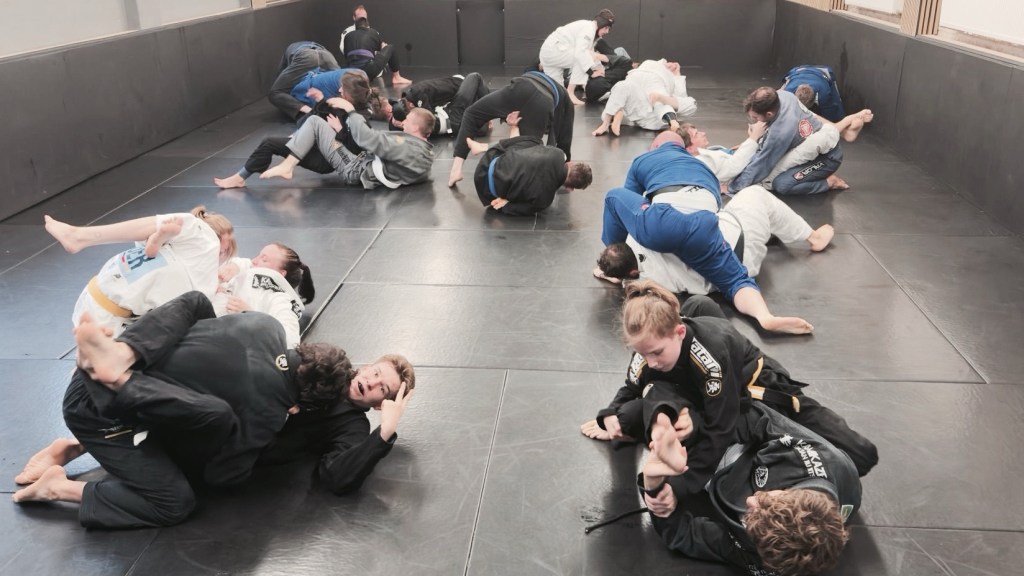
Technique: So lets begin our drilling with a collar sleeve position. Working in pairs the students will use collar sleeve, with a productive but active training partner, to force the top player to either roll to their back or to place a hand on the mat to stop the reversal. The goal here is to learn how to force a reaction with a specific guard, but this directly translates to all guard positions. Literally every guard has the same function.
Discussion: This concept has to be understood before we can develop any type of guard game. I have to establish pull grips and a push position, for the beginners we focus on feet on hips. The specific guard doesn’t really matter at this point. All guards are used to either trap a post and push our opponents weight over that post or to make our opponent extend their arms or legs. For today’s lesson we are using collar sleeve to force an expansion of our opponents arms. So step one is to attempt a sweep. The defense to this sweep will likely be an expansion of the arms to stop the reversal. Using this we step over the shoulder and lock up our triangle.
Technique: Working in pairs, start with collar sleeve and create a pull angle towards the sleeve grip. When your partner defends this action we simply step over the shoulder and cross our ankles in a loose lock triangle. Of course the details of a triangle have been taught over and over, so feel free to check YouTube for the perfect triangle video. The details that I taught are difficult to put into words, so they are reserved for the students who attended the class. The important concept here is creating expansion of our opponents arms as a result of our sweep attempt.
Conclusion: A lot of take aways from this class, but I think the most important is the idea that submissions from guard should almost always come as the result of a sweep attempt. When we make an attempt to sweep we have to be ready to use both situations. Either our opponent is forced to their back, or our opponent extends their arms or legs to defend the sweep. This is our opportunity to attack submissions. We certainly have submissions that work without this action, but in my experience, the submissions that work at the highest levels begin where a failed sweep ends. If you are unable to cause a dramatic reaction from your opponent you likely will not be able to be successful with a submission.
More on this for day 2.


Leave a Reply