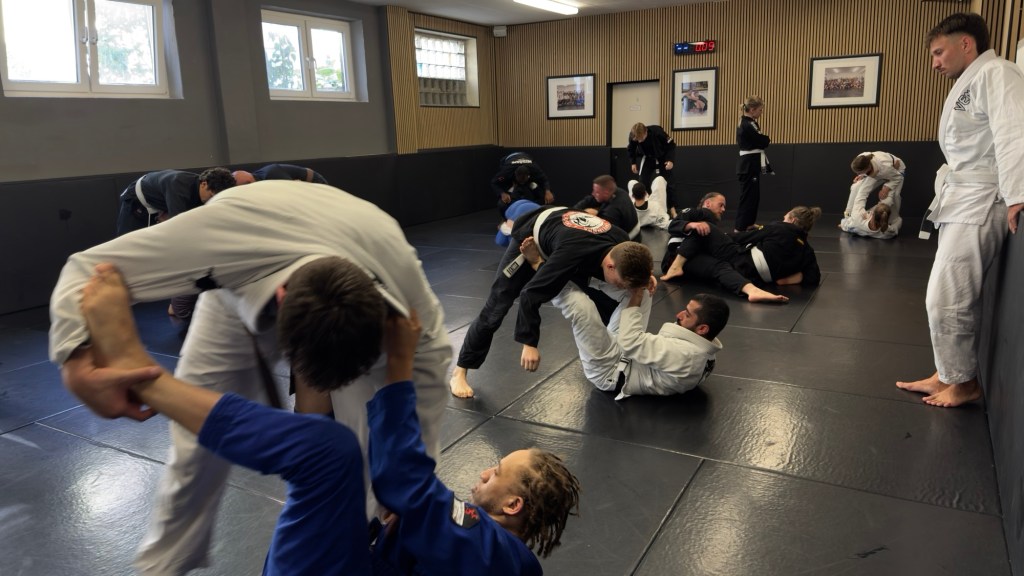
Attacking from the guard has always been complicated. We learn lengthy techniques for submissions and sweeps only to have them fail time after time in training. They work, the foundations are sound, but they are just too overwhelming for a beginner to accomplish in a live roll. So we have to break things down to their simplest concepts.
Last week we talked about the foundation of guard. Guard player typically would like to make first contact with their feet on the guard passers hips. This is a safe, reliable first contact. Then we need to make a connection with our arms. This can be done by making grips on the upper or lower body, depending on which is presented to us. For the sake of mondays class we focused on what happens when our guard passer approaches with upright posture and feet near our hips. In this scenario It makes the most sense to make our grip connection on their ankles or grip the pants. So lets play from there.
For this class we slowed things down a bit and focused more on cooperative drilling with a willing partner. Top player would engage the guard in an upright posture with their feet near the guard players hips. I encouraged the students to play with this control. Anchoring to the guard passers foot or feet, while pressuring through their hips with our feet. This is about as simple as a sweep gets. Anchor the feet and kick them in the hips. This will naturally cause the top player to fall to their hips/butt. I love this because it really is the foundation for all of our sweeps. We have to anchor a post, then push weight over that post. So it teaches a vital concept from a very beginner friendly perspective.
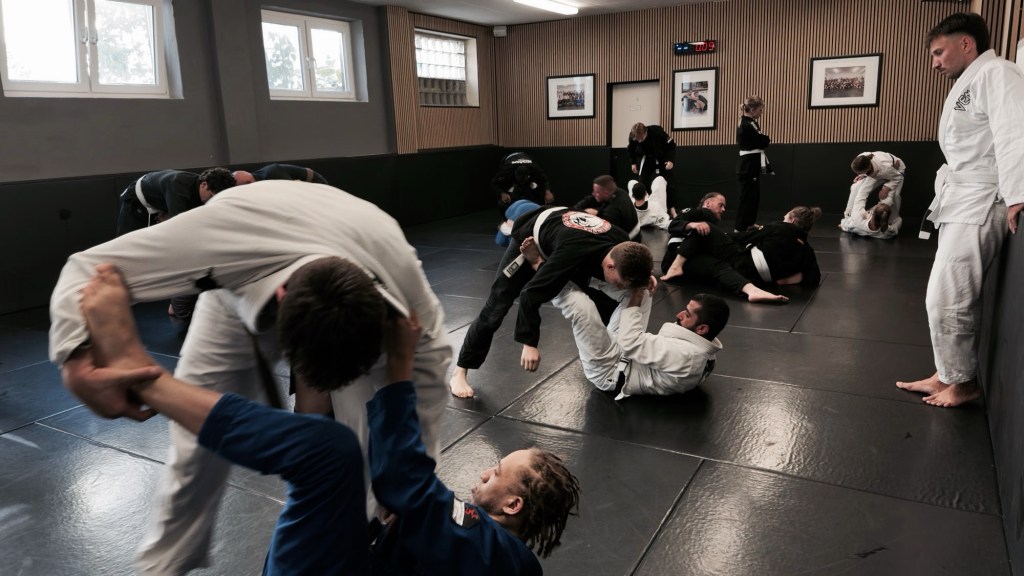
After a few minutes of playing with this idea I was noticing the students identifying the problems with this very basic sweep, so it was time to call them in for add details.
Guard is all about getting the top player to over react. They would love to stay in a safe, athletic position and progress through a guard pass. We need to get them to react in a way that allows us to trap a post, which will then move towards a sweep or a submission. So our first direction will almost always fail, the goal is to learn follow up movements that will eventually lead to a dramatic enough reaction for us to use. So lets take a look at that. If I make connection to my guard passers collar or sleeve and begin to attack their posture, they should defend by moving their hips close to my hips to break the grips and keep me from pulling them down to the mat. When they defend this they open up their feet for attack. So we tried this technique again with our partners. This time start with feet on hips and upper body grips. Move your partner around until the feet step close to your hips. Then make the connection and work towards grounding your partner.
So now we are starting to see the students really understand the importance of movement. I always think about my sweeps like judo. You would never stand still and throw someone. The movement and the timing are what make the throw work, the same thing happens with sweeps. Sweeps trained in a vacuum, with no movement will almost always fail once they are attempted in a live roll. Both timing and technique are important, but without the timing the technique will almost always fail.
The last thing we talked about was utilizing our outside leg. Let’s look at this scenario: top player approaches a guard pass with their left leg leading. This allows me to make a connection with my feet to their hips and my right arm on their leading leg. However, their trailing leg (right leg) is out of reach. So in this scenario the guard player moves their left leg from the hip down to the Achilles to hook the top players right leg. Now we have control of the top players lead leg with my hand and their trailing leg with my ankle. From here we simply push with our right leg and tip our partner to their hips/butt.
So lets see what happens when we spar this. I set the timer for 1 minute rounds. I asked everyone to play this strict scenario. Top player must stay engaged but is not allowed to drop to both knees or pass the guard. Bottom player just needs to put one of the top players hips on the mat. Not a full sweep, simply bring a hip to the mat for a win. We ran this for 6 one minute rounds. Each pair spent one minute from guard and one minute from the top position before moving to a new partner.
Overall, one of the simplest classes to teach. Many of the more advanced students struggled to make it work. They defended the sweep attempts perfectly and shut down the guard player relatively easily. Which is totally how I would have expected them to react. This class is simply the foundation for guard work. If I can get really good at attacking sweeps with ankle control then it will force the top players to engage with their upper bodies, which is ultimately what I want. 90 percent of our guard attacks happen with upper body control. So we need to get really good at upsetting balance through the lower body if we want to learn to effectively attack the upper body. This is the foundation that most of us skipped. We have to learn to play with upper and lower body if we want to force intelligent grapplers into unfavorable positions.


Leave a Reply