Last night really highlighted the need to focus on one topic for long periods of time. Monday was difficult for most of the students simply because it was a new idea. We typically go into a match with offense in mind, from both grapplers. When we focus on being defensive while maintaining a safe position behind our opponents guard we let them do the work for us. Our focus is simply on breaking down all of their attacks. So as bottom player gets a grip, I immediately break it, when they begin to unbalance me, I return to center. So after reminding the class of the task, we jumped right into our games.
Game 1: This was the exact same game from Day 1. Groups of four students. The active player would stay on top and safely behind the bottom players guard for 30 seconds. Bottom player could sweep, submit or stand up to win. Top player repeats this drill with all three pod mates.
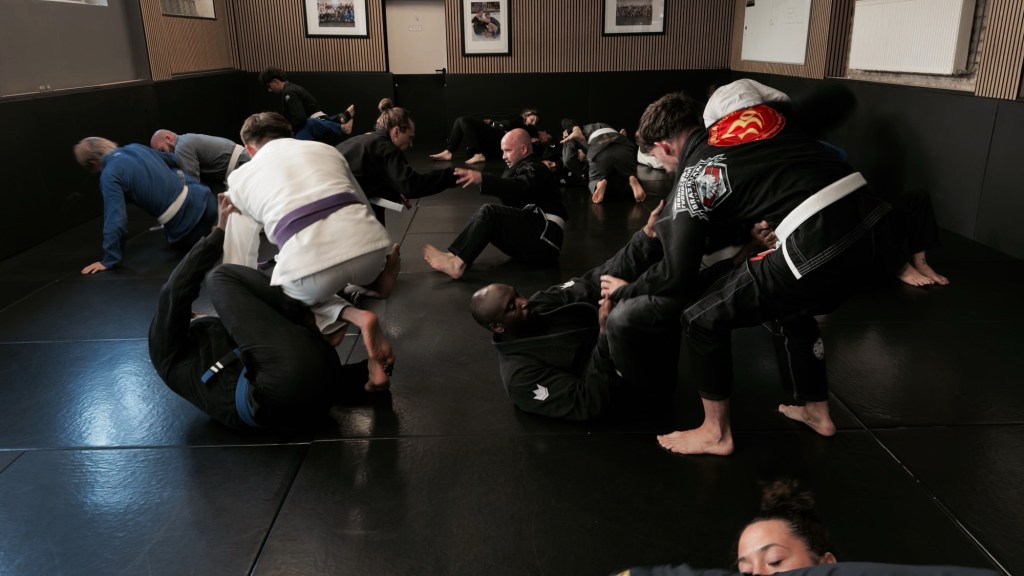
Discussion: Significant improvement from day 1. Now that the students had context and some experience they really worked to implement these tactics and had much more success. It’s important to know that the top player doesn’t need to know everything about the guard to successfully defend and stay safe. A few concepts cover almost everything that can happen from the guard. So lets start with a very basic idea.
In most cases the guard player has their feet or shins on our hips, this is the main hinge point of our bodies. This means their arms are typically either attached to our upper body, creating a head down hinge, or connected to our legs, creating a head up position. When the guard player connects to our upper body with their arms we need to react by lowering our hips and working to force a head up posture. Doing this will help to defend against those attacks. When the guard player attached their hands to our legs we need to move to a head down position to defend against those attacks. For instance: Guard player has their feet on our hips and their hands on our ankles. In almost every situation this means they will anchor our feet and push us back over our heels, creating a sweep. To defend this I simply bring my chest down parallel to the guard players chest and make an attachment to their upper body. This will make those sweep attacks difficult for the guard player. Of course this is usually followed up with guard player transitioning to upper body grips. To which I will lower my hips and move to a head up posture.
These are the two main attacks from the guard. Of course there are an infinite number of possibilities from the guard, but almost all of them break down to this simple concept. So I don’t need to know what attack the guard player is planning. I just need to know these two concepts.
Game 2: Same game, only we extend the work time to 1 minute. Top player stays safely behind the bottom players guard. Bottom player rotates every minute. Bottom player wins by sweep, submission or by standing up.
Conclusion: I really like where this is going and I noticed an improvement immediately. Once the students understood the object of the game they were able to increase their success rate substantially. It can be so hard to get students to understand this simple concept. It’s like they say, breaking a bad habit is harder than creating a new one. I think this is especially true for this block. The less Jiu jitsu the students know the better off they are. This is an important foundation that all students must understand before they start with guard passing. I have to be able to remain on top, in a safe position behind the guard before I can safely start my passing.
More on this next week


Leave a Reply