Monday kicked off our defense block, which is scheduled for 8 weeks. Defense can be a difficult topic to teach to beginners. I always want the new students to tap often and early. This is the only way they will stay on the mats, but I also need them to start understanding the difference between a panic tap and the true need to tap to stop an injury. As we progress in Jiu jitsu we find ourselves more equipped to make the split second decisions necessary to either tap, defend or escape. Soon we find ourselves fighting out of deep submissions that would have been match ending when we first started.
I asked the students to begin their drill at the very end of an armbar submission. I asked them to not defend at all, but only to feel what its like just before they are forced to tap. This also required the trust and assistance of our partners. The offensive player was asked to slowly increase pressure until the bottom player was forced to tap. This can’t be a live motion at full speed, the point of this drill is to identify what’s happening to our arm as we are forced to tap.
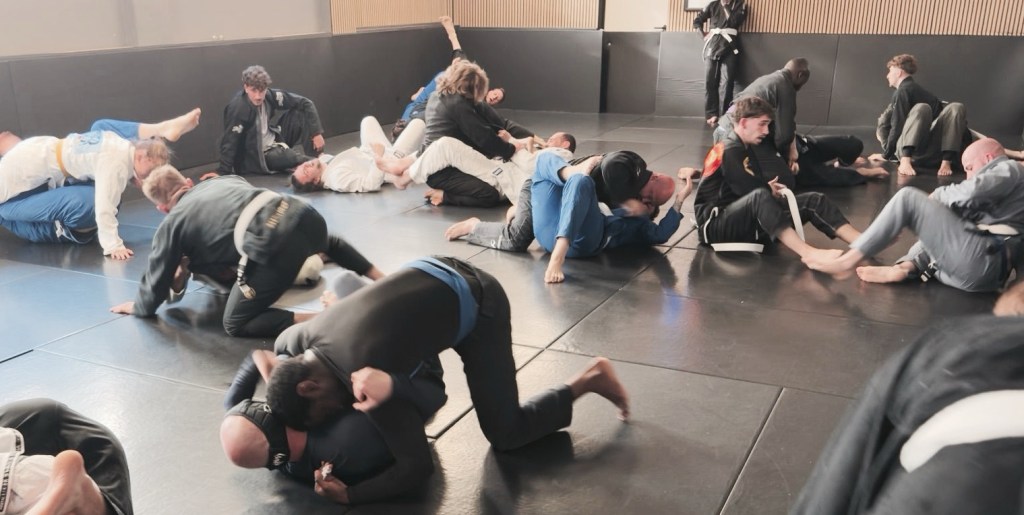
Once the students had a better feeling of what it felt like to reach that 99 percent range of motion, then we could move forward into the basics of defense. Once the arm is straight we no longer have the luxury of true defense. True defense in an armbar would be arms locked together in some configuration. Once the grip is broken we are no longer defending but rather escaping. This is a very important distinction to make:
Its very hard to escape while defending and its very hard to defend while escaping.
Once the grip is broken we have to be actively escaping or tapping. We have two primary options from here 1) we change the angle of our wrist or 2) we change the angle/elevation of our shoulder. Changing the angle of our wrist is a temporary fix, as our opponent will likely correct this. Changing the elevation or angle of our shoulder is a much better solution. We see both of these options used in our Reverse hitchhiker and Hitchhiker escapes. The Reverse hitchhiker is a great option that we have seen work with great success at the highest levels. More recently it has become the preferred escape option for many ADCC competitors. However historically we have focused more on the traditional Hitchhiker escape, so the main objective of the class was to teach this. You can find great instructionals on both of these techniques on the BJJ Globetrotters YouTube channel.
Conclusion: Overall a great class, as always I wish I had 5 weeks to spend on each topic to really drive in the details, but this is where I set the students free to explore it on their own. I want my students to be escape artists, but I also need them to stay injury free. This is a tough line to walk, as escaping or defending submissions inherently increases the risk of injury. So explaining this has to be repeated every time we talk about defense. Ultimately students have to decide where there comfort zone lies, some will always tap early, some will roll the dice and take bigger risks, both are right


Leave a Reply