This week we change things up a bit and jumping right into positional sparring. Not with our usual pods but in pairs. The goal here was to do 18 two minute rounds starting from the back, with very minimal intervention by me.
The class started with a quick reminder and explanation. I wanted to make very clear the starting position, back with hooks and a standard seatbelt grip. I also wanted to make sure the students understood the difference between their choking arm (overhook) and their control arm (underhook). This is an important distinction for both the offensive and the defensive players. From here the rules were very simple. The player who has the back must submit with a choke from the back. Any deviation from that would result in a win for the defender. It’s important to understand that while we have lots of options from the back, including abandoning the position for armbars and triangle chokes, we should prioritize maintaining back control and focusing on chokes. This is going to be our highest percentage win and reinforces the importance of dominant positions for our beginners.
Round 1: 2 minutes offense, followed by 2 minutes defense with the same partner. We did this with 3 different partners for a total of three 2 minute rounds on offense and three 2 minute rounds on defense.
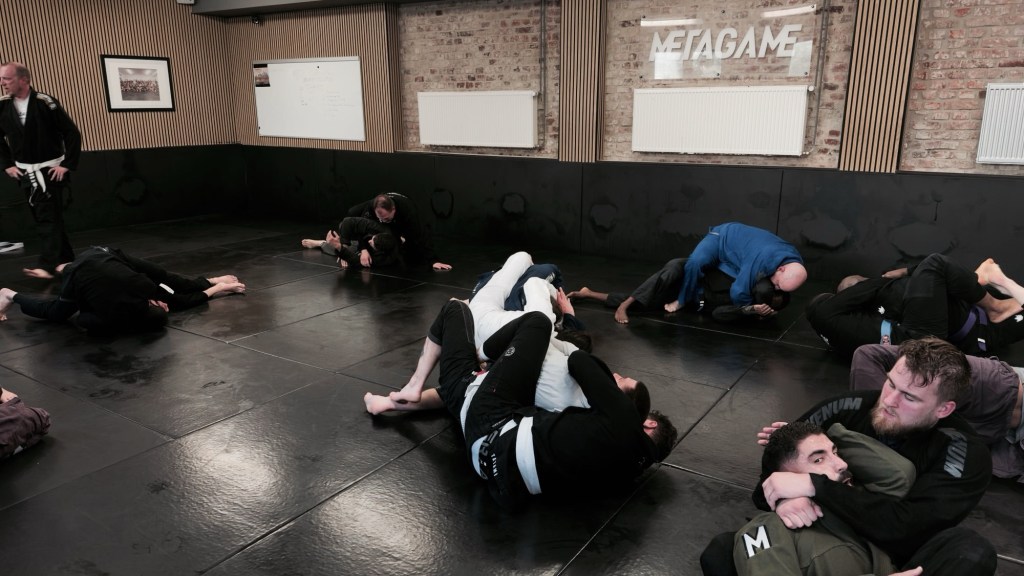
For the next situation I wanted to make things a little bit more difficult on the offensive player. So we started with only one established hook and the second leg on the mat behind our opponent. Our quick discussion focused on the clamp/move concept. When I have a seatbelt grip I am able to maintain that chest to back connection that is the basis for our back control. Without our hooks we should still be able to control the position for a long time. Conversely, if we use only our hooks with no seatbelt grip we can only maintain the back position for a brief moment. So we clamp with our arms via the seatbelt then we move our legs into position to create hooks. These hooks need to clamp our opponents hips in order for our arms to move towards chokes. If we relax our arms to move to a choke and also relax the clamping of our legs then our opponent will escape. This is an important concept that even experienced grapplers miss.
Round 2: 2 minutes offense, followed by 2 minutes defense with the same partner. Three partners total for a total of 3 offensive rounds and 3 defensive rounds. Offensive player must choke from the back, defender must escape. Any change of position results in a win for the defender.
Our third and final situation moves us farther from back control. This time we have a strong seatbelt grip but we have no hooks. We start with both of our legs on the floor. No additional concepts for this third round, just a brief reinforcement of the previous concepts.
Round 3: 2 minutes offense, followed by 2 minutes defense with the same partner. Three partners total for a total of 3 offensive rounds and 3 defensive rounds. Offensive player must establish both hooks and choke from the back, defender must escape. Any change of position results in a win for the defender.
Conclusion: Overall great work from everyone. Almost everyone was able to win via submission at least once, almost everyone was able to escape more than once. I would call that a win, especially when we are still only a few weeks into our back block. As always, I mentioned we have a lot of options from the back. However, abandoning the back is always a risk. Our focus should be on maintaining the back once we have gotten there and working to improve our chokes. Any other option means we are risking transitioning to an inferior position. Our matches need to be 1) get to the back 2) finish from the back. Full stop. If a submission presents itself on the way to the back we should take it, but the goal should always be the same… GET TO THE BACK


Leave a Reply