Being away from the gym for three weeks has helped me to assess the progress of the students and reshape the curriculum quite a bit. I will always go into the year with an outline of tasks, but that outline is meant to be shifted and shaped to fit the needs of the program. Right now I see a pretty big need for staying focused on the back. I’ve always said every match should start with a handshake and end with me on your back. Sometimes the pursuit of the back results in me finding a submission along the way, which I will gladly take, but my effort is always on getting to the back. So its important we stay focused on this goal. When I was teaching children Jiu jitsu that was 90 percent of our curriculum. Get to the back at any cost and rear naked choke. This linear pathway worked great for kids. They attacked the back with a singular mindset and it often worked well. With the adults I want to develop more strategies and implement more techniques but ultimately I want them to have that same drive to attack the back.
So June continues on with this theme. Last night we talked about half guard and the importance of winning the outside underhook. From half guard both top and bottom players desperately need this under hook. It is what determines who is winning the position. If neither player has the outside underhook the position is largely 50/50. So we began class with this as our primary focus. We worked in pairs as opposed to our normal pods and we worked without a timer. So lots of reps with communication to see how we could achieve this underhook. Both top and bottom players were able to win by getting the underhook. This lasted for about 7 minutes.
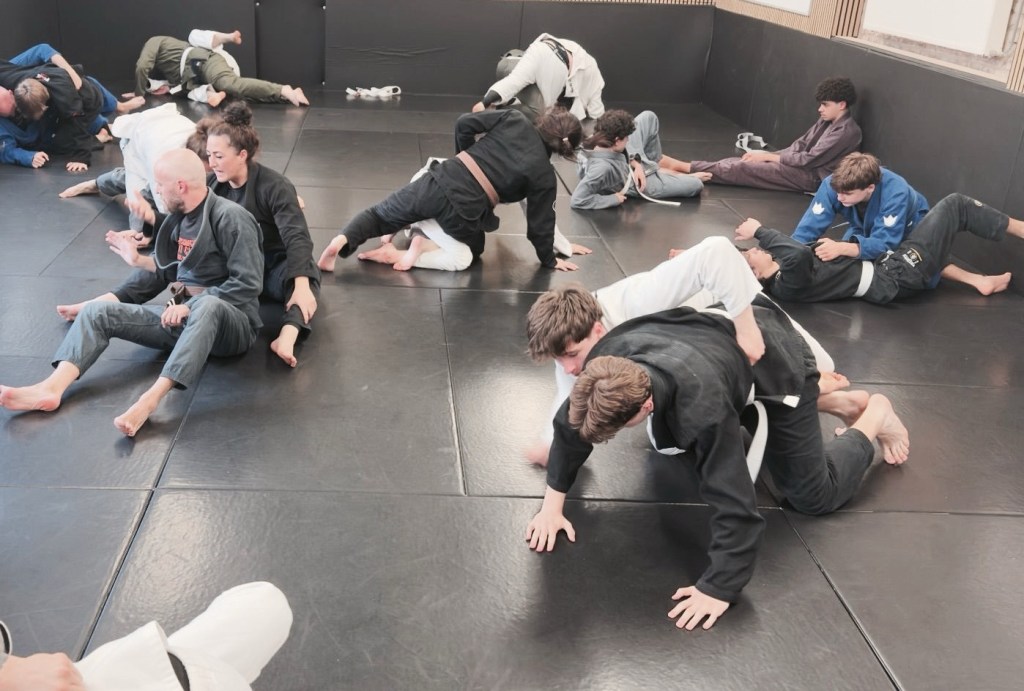
Discussion: At this point in the curriculum most of my students have enough context to understand how to drill. Meaning they know enough about how a roll is supposed to look that they can react in a productive way both without flopping like a dead body nor fighting the drill to the death. So we are able to slow things down to a step by step approach to the technique. I began by demonstrating the use of the underhook from a topside position. Almost every guard pass requires an outside underhook, so learning how to defend against this is the first task as a guard player. From half guard the knee cut pass is our biggest risk and we can stop this in most cases simply by denying the underhook. Then I moved on the the technique of the day. Once I have secured the outside underhook from the bottom half guard position I start to build a base and make my way to the back. I do this by gripping the belt or waist with my underhook and moving to an elbow frame on the mat with my opposite arm. As I begin to make my climb to the back I have to then clear my head. Sometimes our opponent will headlock us in an attempt to stop the progression to the back but this is a losing battle. Most skilled grapplers know to abandon this and start for their recovery. This was the first thing we drilled. Starting from half guard bottom, gain the advantage by securing the outside underhook, then build our posture with our elbow frame, finally clearing our head from the headlock.
Everyone seemed to understand this very well and the drilling went better than I had expected. I did receive questions about the amount of resistance needed which is perfect. These questions mean the students understand that finding the middle ground is important. This is where communication with our partner is super important. Some training partners need our assistance in the techniques, so we have to not only offer less resistance but also help them with our bodies along the way. As we get more comfortable with the drill we want to increase that pressure and resistance so that it closer matches what we would expect from a live roll. The challenge comes from the extreme end of drilling. Meaning what to do when both grapplers are comfortable with the technique and need a more realistic feed. At this point resistance is maxed out but we still don’t want our training partners to make an attempt to escape or progress their position. We only want them to resist. This can be tricky for even experienced grapplers to grasp.
Now we moved on to securing the back position. This comes from first getting to a tight head trap seatbelt position. It’s important we don’t move our legs before our arms are secured or we risk losing the position. Don’t forget the rule: If our arms are moving our legs must be clamping. If our legs are clamping our arms can be moving’ we always want to progress in this pattern when we are learning new techniques. This will greatly reduce the risk of failure. Once we have a tight head trap seatbelt then we can use our legs to break our opponent down to a hip and start working on the topside hook.
Again, great work from everyone on the mats. This technique is pretty straight forward but its conceptually very important. Understanding the value of an underhook is paramount to early success in Jiu Jitsu and often times is the beginning of a back take.
For day two we will flip this position and show how we can attack the back from half guard top using the same concepts. Ultimately ending in a modified chair sit position. This should be a great day for drilling before entering a sparring week for week 17.


Leave a Reply