Our second day of mount escapes will mirror day one in most ways. I started class with a brief introduction to half guard as a means to recover. I wanted the students to understand that getting to a butterfly guard or full guard position was the long term goal, but sometimes the pathway to a full escape runs through half guard. My big focus with a valuable guard is being able to bring my knee to my chest uninterrupted. I need the students to value that above all else. With a basic half guard position we are still blocked from doing that. So while we can establish this as an improvement from being mounted, I would still like my white belt students to understand the importance of a productive guard that allows their knees to close to their chest.
Game 1: The task of this game is exactly the same as day 1. Bottom player is escaping mount for 3 minutes, groups of 4 students. Bottom player ends the rep by establishing some kind of productive guard, or by ending up on top in any configuration. Top player is looking to secure the back or submit to end the rep.
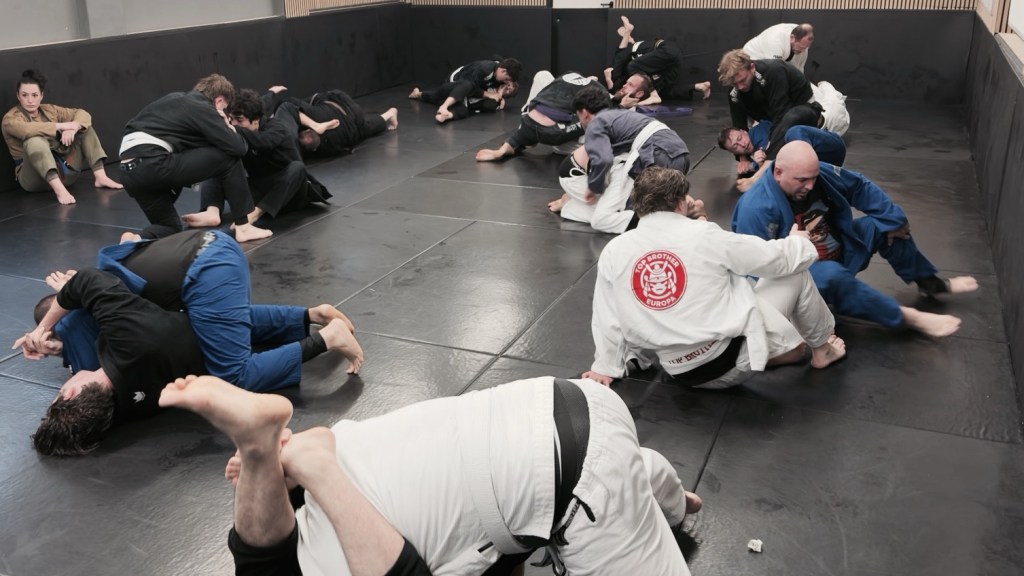
Discussion: At this point in the curriculum the students seem to be understanding the value of asking questions. Unfortunately the answer tends to be “you just need to keep trying”. I wish I had a bunch of cool tricks that would solve the problems. I don’t, but even if I did it would still take time on the mats to make them work in live situations. The students are starting to understand you can’t simply move uninterrupted. Every action towards an escape should be met with a wall, just as every action towards a submission should be hit with a wall. This is what makes Jiu Jitsu work. I still want my students to understand the value of movement, without worrying about the bad things that can happen. If they continue to aggressively work towards their escapes then they will be hit with submissions and positional advancements. This is what ultimately makes them better. It’s these failures that force them to adapt and try something new. Then its my job to come in and add a few pointers to keep them working in the right direction.
Game 2: No changes in the game format or rules. I needed the students to understand the scenario in which they played. So I reminded them, with each rep, the match has only 30 seconds left. Top player is mounted but still is down on points. So they need to advance to the back (score 4 points) or submit to win the match. Bottom player knows if they are able to get to a productive guard or be on top they have a much higher chance of winning the match. This scenario is important for several reasons. One it encourages activity. The worst thing that can happen in this game is nothing, we need the students to be actively trying to win. Secondly, more often than not, the best time for bottom player to escape is when top player is advancing. This movement can allow us to work to a better position. When top player is just pinning its incredibly hard to escape, so we wait until they start to move then we can move much easier towards our escape.
Conclusion: I feel really good with this block. As always I wish we had another month of this position. In the end we had only a very short time in both top and bottom mount, but I think we accomplished a lot. We have been able to fit 3-4 rounds of live rolling in at the end of each class and I’ve seen a lot of our practice positions showing up. This means the students are not only recognizing the games within the live rolls but they are able to win the positions just as they did in the games. The games absolutely have to mimic live scenarios. If the games are built correctly the students should be able to recognize them and put their new skills into action. That’s the goal…


Leave a Reply