Last night was our first mount class. The goal of this practice was very simple, how long can you hold mount. As always we started with our four primary movements, forward roll, backward roll, granby roll and sidewinders. Then we quickly got into our pods of 4 and I began to define the terms. The opening description was very brief. I simply showed the mount position and explained the three options for arm position. Top player could either have double unders, double overs, or a mixed arm position with one under and one over. If bottom player changed position in any way that defined a win. So if bottom player moves in a way that forces top player to take their back, then that ends the rep. The same goes for any guard position, knee on belly, side control or north south. Any change in position constitutes a win for bottom player.
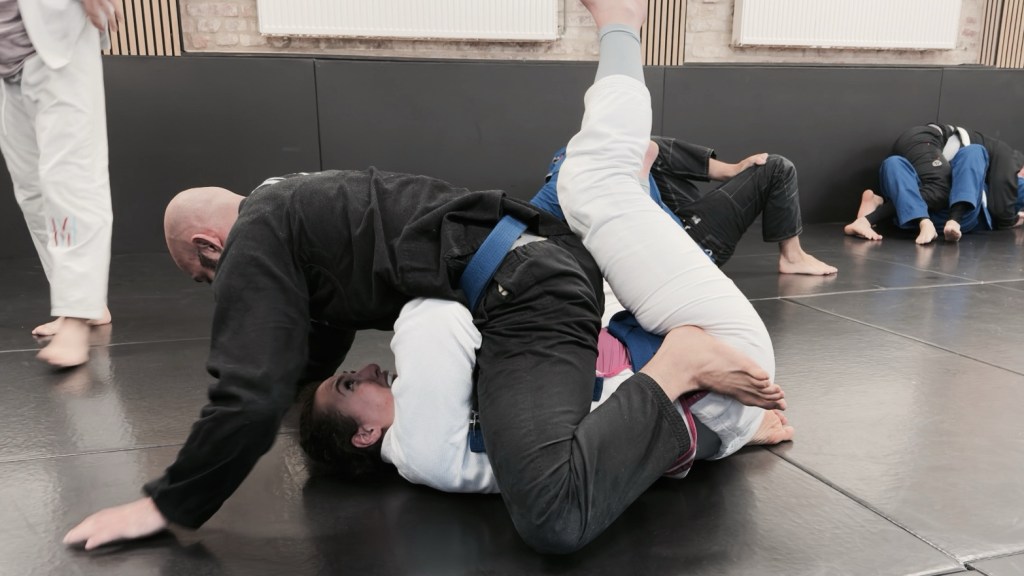
Game 1: Groups of 4, top player stays in for 3 minutes, bottom players rotate in at the end of a rep. Top player can only win one way, maintain mount for 3 minutes. Bottom player wins with any other change of position.
Discussion: This was interesting because top player quickly realized winning was nearly impossible. I saw a lot of great problem solving during this first round. One common mistake was top player thinking they could just anchor to bottom player and control them indefinitely. This almost always resulted in a reversal of position. Bottom player could simply roll over since the top player had committed his arms to clamping and completely disregarded posting. So I had to address this. We talked about problem solving, understanding that the bottom player will rarely make their escape in one movement and that they need compound movements in a series to make an escape. Remember, if I’m winning a position my goal should be to reduce movement. If I’m losing a position my job is to create movement. So as the bottom player is building an escape I need to be actively taking those building blocks away from them, one by one.
Game 2: No changes to the game format, just a replay of the first game with added context. The realistic goal should be 30 seconds of strict control time before bottom player forces a change of position. Even this will be tough. This game is definitely weighted towards the bottom player, when the players are all beginners.
Conclusion: Overall a great practice. The beginners saw a lot of success once we redefined what a win was, the idea of pinning for 3 minutes wasn’t realistic (for a beginner). So when I gave them a goal of 30 seconds the game became much more fun. This was a much more frustrating class for the intermediate and advanced students, mount can be a very frustrating position to be stuck in and some of the advanced students struggled to maintain mount for an acceptable amount of time. This just highlights some deficiency in their games. They often struggle to commit to fixing these problem areas, simply because its not fun. They would rather surf through positions or work to a submission, but pinning and control are a very important part of the game at the highest levels. All the greats had great pins. This is our chance to work on the boring stuff, the stuff that makes or breaks tough matches

 The Superstition Club
Leave a comment