Today we will deep dive into multiple outcomes allowing for more Jiu Jitsu to happen throughout the drill. We need to understand the importance of the inside underhook as a means to advance our position. My first action from turtle is to separate my hips from my opponents hip, only through this will I have the space I need to swim my inside arm for the under hook. This motion, my hips turning away as my head closes distance to my opponent is vital for advancing position. In almost every scenario my opponent wants to stay hip to hip and I need to create that separation. Once I’ve established an under hook I can use this to create the space I need to either work to a stand up or sit to a productive guard. Don’t forget, my opponent needs an underhook to pin, if they try to achieve side control without it I should be able to scramble to a topside position. So this under hook is the real battle of the position.
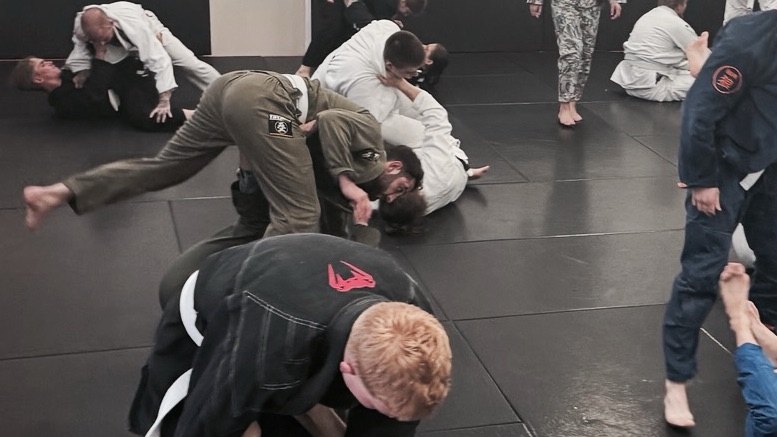
Game 1: Repeat the second game from Monday. The bottom player starts in side control and top player allows them to transition to turtle. Once the outside knee touches the ground the drill becomes live. Today I’ll encourage the grapplers to keep the drill moving until a more specific position is achieved. Bottom player needs to have a strong, established offensive guard. Top player will continue to advance until the position is stabilized. Bottom player can also win by ending up on top of top player in any configuration. Top player can end the rep by pinning for three seconds in side control or by securing the back for three seconds. Top player can also win by submission, today we will open up the submissions to allow for all subs. Until one of these task are completed the drill will continue. The grapplers are encouraged to lengthen the drill. This should allow for a lot more action and new positions.
As always, groups of 4, 3 minutes to work from the bottom position, top player rotates, bottom player stays in for three minutes.
Discussion: I really wanted to emphasize the importance of an under hook. Both for the top and bottom player. Like many positions, the person with the under hook will be in the better position. So I quickly demonstrated how I swim the inside arm in for an under hook as I progress to turtle. The second point I wanted to repeat was to move my hips away from my opponent as I turtle. This will keep the top player farther from securing the back. The combination of these two actions, the under hook and the hip separation, is ultimately what determines the outcome.
Game 2: Repeat game one for a last time. This time I really pushed the students to be aggressive. I allowed more grappling to happen and forced both top and bottom player to be in a dominant position before the rep ended. The same format, four 3 minute rounds. Active player is on bottom starting in side control. Top player allows bottom player to turn to turtle and the game begins when both turtle knees are on the mat.
Conclusion: Overall I’m very happy with this block. I really wanted to highlight turtle as a means to recover guard or work to a standing position, but I also wanted to show the students that there are risks to exposing my back. Ultimately the turtle happens because our opponent got the best of us, even momentarily. We used turtle as a means of recover, not as a primary action. Both sections of this block exposed the strengths and weaknesses of the position. I think everyone came away with a better understanding of how to use the position, without exploiting it as a long term defensive shell. Next up we will be discussing mount, starting with progressing towards mount from a side control position. I think this should go smoothly as the previous block was focused on side control, often times with the reps ending in mount

 The Superstition Club
Leave a comment