Today we will focus more on our hips. From both the bottom and top position the hips tell the secondary story. I still want our main focus to be on tight waist or under hooks as those are the building blocks for winning this position, but I want to spend a little bit of time talking about winning that secondary battle. In most cases, the bottom player wants to separate their hips from the top player. This helps to reduce the risk of a back attack and allows bottom player to work to a stand up or recover guard. Conversely, the top player is trying to maintain a hip to hip position. This allows the top player to continuously pass the guard when a guard recovery is attempted and also allows the necessary positioning to win the back attack. As the bottom person attempts to separate the top player must continue to close that distance. For today’s lesson I want to emphasize the effects of the turtle entry. So we will begin our reps in a loose side control and have the bottom player roll over to turtle. When the bottom players second knee touches the mat (landing in turtle) the rep is live.
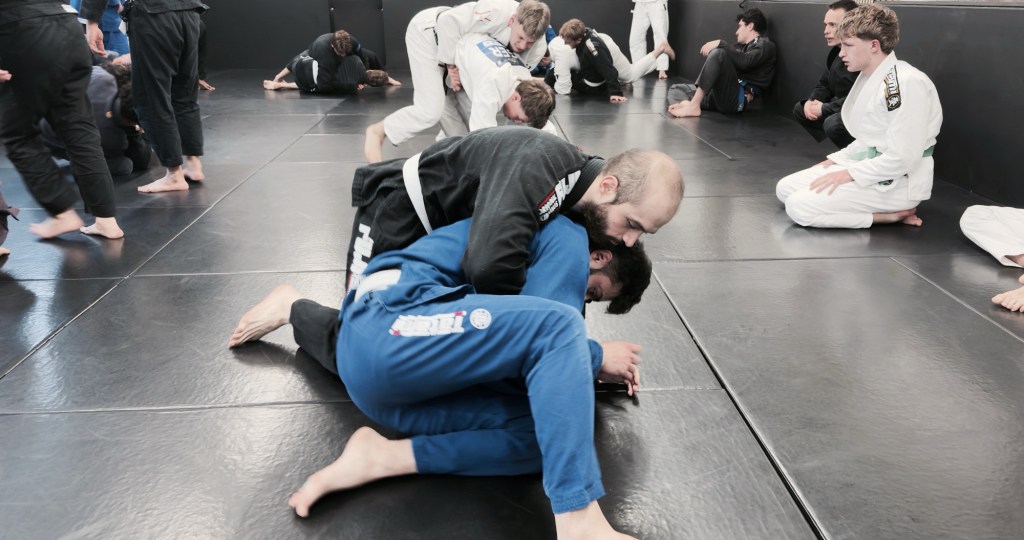
Game 1: Same format as day one. 3 minutes a of action, 4 rounds. Top player stays in for the entire three minutes while the bottom player rotates out at the end of the rep. Top player has two ways to win, they can pin passed the guard (side control, north south, or mount) or they can secure the back in a scoring position. Bottom player is attempting to recover their guard or stand up and separate.
Discussion: I can see the students processing the information. They know to win the tight waist and keep hip to hip, but, just as in the previous block, they struggle when making the transition from control to attack. They are losing on those exchanges. Typically this is happening because the top player is trying to race to the next position. Don’t forget, in almost every scenario, the player winning the position wants to slow things down, the person losing the position wants to speed things up. So we have to mitigate those scrambles if we want to not only maintain our position but also advance to more dominant positions. This is highlighted by the bottom player initiating the drill by turning over to turtle. Top player must stay tight and begin work on winning the position right away as the bottom person is going to make a quick movement towards their escape or recovery.
Game 2: No changes in the game rules or format save for allowing submissions. Top player can now submit, pin or take the back to win the rep. Bottom person is still focused on recovering a meaningful guard or standing up. Again I’ll push the students to put themselves into a competition like scenario. Top player must score or submit to win the match, bottom person is ahead on points and only needs to recover guard or escape to stall out the time and win the match. We only have 30 seconds left in the match and its time to go!
Conclusion: Turtle can be such a complicated position. Many great grapplers have made this their specialty and have had enormous success with it. So its important that we learn how it is used. It’s impossible to become proficient at anything in 2 hours so this will take work. These practices are meant to be the building blocks of your game. We spend a small chunk of time focused on improving one small aspect of our game. Then we open the mats for live rolls, here is where the real work comes in. Are you willing to get better at a position you’re not great at, even when no one is telling you to do it? We have to go into these rounds with a plan. I can’t tell you what you should be working on when the rolls are live, thats for you to figure out and work on. What I can do is structure our practices so they flow into each other. This focused attention is the base you work from.
Next week we will focus on turtle from a bottom position. This gives us two more classes to also be working on our turtle top skills, giving us 4 classes total on turtle. Not even close to enough time to be good at this, but Rome wasn’t built in a day. We’ll revisit turtle with more details later in the year

 The Superstition Club
Leave a comment