I don’t like to spend a lot of time on submissions with beginners. I’ve always felt positional dominance and understanding is significantly more important than submissions. Everyone wants to learn submissions, but if you only focus on them without learning how to control then you’ll never find yourself with the opportunity to use them. Conversely, if you learn to control your opponent you will end up finding ways to submit them, even if you’ve never been taught a submission. So we kept things very simple. The Games are always formatted the same way. Groups of 4, one player stays in for 3 minutes, the other three players rotate in to give feeds.
Game 1: we are building from day 1 and day 2 so those tasks are the same. If top player can control for 3 minutes, they win. If top player can advance to either mount or back control, they win. But now we introduce one new way to win. If top player can isolate bottom players outside arm that also constitutes a win. This is important so both players can understand the risk of limp isolation. The goal here, as a coach, is twofold. One I want top player to see they can use the risk of limb isolation to advance to a winning position. Two I want bottom player to realize the potential for escape when top player is singularly focused. As I’ve introduced layers to these games I saw a noticable change in the pacing. On day 1 top player failed almost immediately. On day 2 top player started the day racing to advance and failing almost immediately, but quickly improved that by slowing down the reps. Day 3 has started off with a predicted regression. When given the opportunity for a new pathway to win, controlling the outside arm, the top player failed almost immediately. For me this just shows that the pace of the classes is moving too quickly.
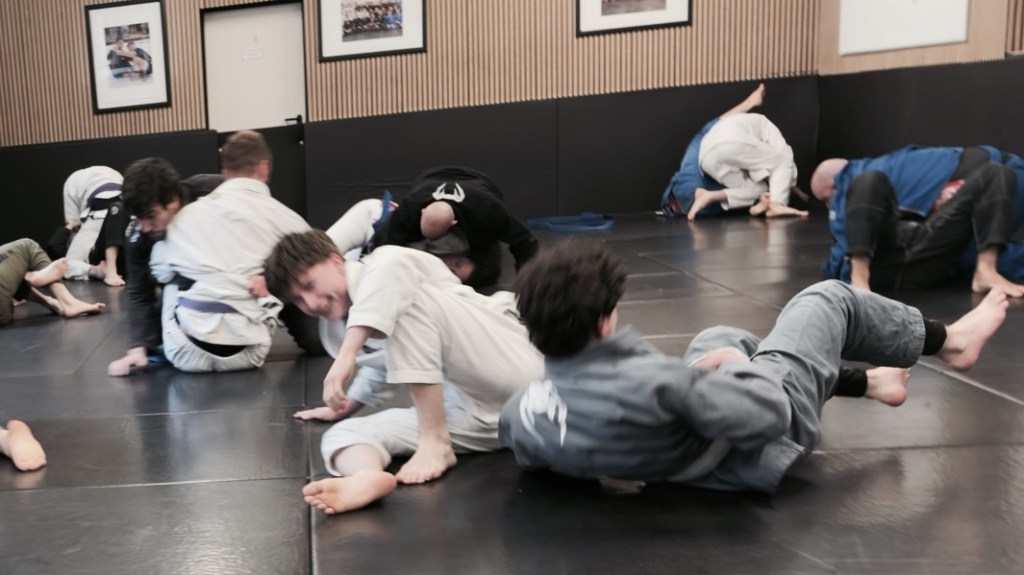
Discussion: Lots of good feedback here. One interesting point made by several students is that they ended in a draw. Top player isolated an arm as bottom player established a guard. They were not happy when I explained why that was a win for bottom player. More on that once we slow things down for a submission block. I have found that it always takes two rounds of a game to really see the growth I want to see. Ideally we would spend a month on one game, repping it into oblivion. I think that is what is necessary to really be proficient on a position. The problem comes down to attention span. My job as a coach is to balance interest with proficiency. I know that my students will only stay focused for so long, they need to feel like they are learning something new and they want to play new games. So thats why I move quickly through the games. One way of balancing this while favoring the side of proficiency is by layering the games and the curriculum. On day three of this very similar game, I expect to see the winning task of day one improve. Which it has, the control time has improved and im seeing less immediate escapes from bottom player.
Game 2: No changes in this game. I just want to see if the students can implement some of the tips I’ve given them. I’m seeing them progress exactly as I had hoped. But I can’t help but to notice the amazing guard recoveries im seeing. This will make the next block so much fun.
Conclusion: Overall another great lesson. I wish I had more time to deep dive into these games. From a coaches perspective time is always the hurdle to overcome. When you watch youth wrestling you notice they will drill and run practice exactly like coach instructs for months on end. I never remember being bored in a wrestling class, never wanted the coach to show the next cool technique. We simply ran through scenarios for months and months with the goal being that we get better at winning those situations. I think that’s something that adults struggle with, we constantly want to drill the next cool flashy ninja move.
So I really struggle, as a coach, to keep the students interested for a long enough time to have them gain some proficiency. So far, I think my format of top position then mirrored bottom position helps to trick the students into spending more time on one position. We’ll certainly come back to these same positions later in the curriculum, but for now 4-6 classes per position seems to be the threshold for interest.

 The Superstition Club
Leave a comment