Today we allowed our top players to advance position. I wanted to keep it narrow, so I only gave them two ways to end the rep. Either they progress to mount, or they are able to secure the back. Two important scoring transitions from side control. I didn’t offer knee on belly as a winning position only because I wanted them to focus on true positional improvement and I see knee on belly as more of a segway position. I began class with defining terms. For today I wasn’t focused on a 3 second control to score points. Only that top player could advance to a scoring position. So I didn’t need to define scoring. Only show them what mount looks like and what back control looks like. I also needed to define the task for bottom player, recover some form of guard (knees or feet on top player, or capture a leg), stand up, or end up on top.
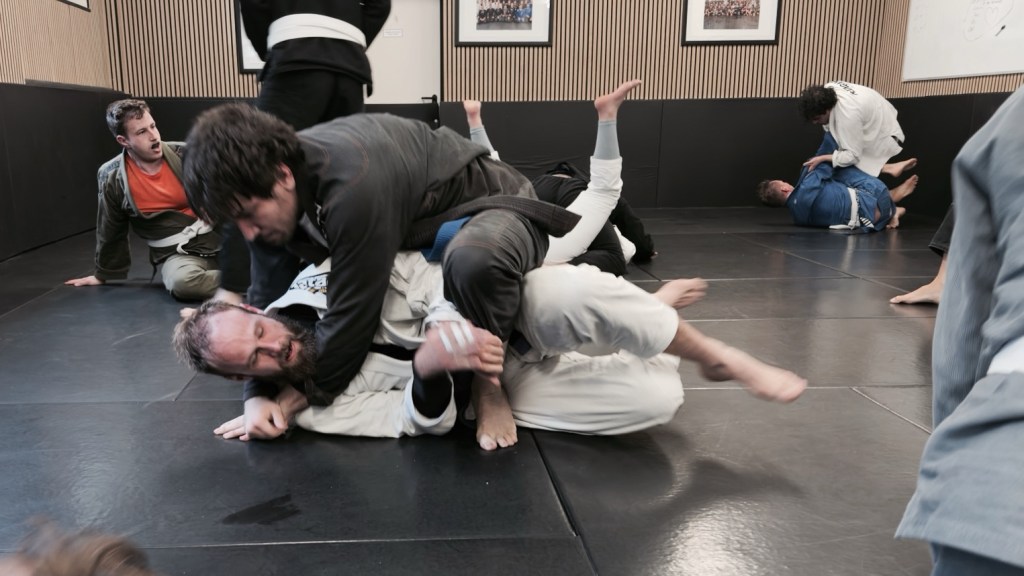
Game 1: Four 3 minute rounds, with each active player staying on top in side control for the full 3 minutes.
Discussion: An interesting thing happed right away. Top player completely forgot about my rule “if you’re winning, slow things down” and they raced to mount. Which was immediately defended and they ended up in half guard. Failure is such an important part of this process. Sometimes you’ll go through an entire class without winning a rep and thats ok. There’s so much to be learned from a loss. Over the course of 3 minutes I saw noticeable improvements. The pacing slowed and the success rate sky rocketed. That being said I still think this is a game designed with a low success rate.
Game 2: Same format and rules as game one, just with added context from our discussion.
After the first round of games I called the group in to discuss and review. Lots of great questions. My favorite being a comment about control. “I can control, but when I try to advance I lose right away”. Bingo, thats just it right? This is where I have to move like lava. I need to understand how I can control a resisting opponent with part of my body while advancing with another. This is incredibly difficult to do and even harder to teach. So we have two separate problems to solve. The first being how can I control while also advancing. The second problem is how can I stay in a dominant position if my opponent is able to move. I introduced the concept of surfing through North South. My opponent wants to move their hips under mine, I need to stay away from their legs, North south is the perfect way to maintain a chest to chest connection while also keeping away from their guard. So we use surfing to stay away from the guard and we use pressure to mitigate movement. This helps to solve the second problem, but how do we control while advancing? Time for round two, lets see if they can figure it out.
Round two saw significant improvements. Specifically in the control. The rounds looked a lot like what day 1 should have looked like. Control time increased and the rep turnover plummeted. This is exactly what I wanted to see. Even though the students didn’t feel like they were winning, they were actually doing everything I had hoped for. They were beginning to understand that white belt Jiu jitsu is about control. You have to be able to control someone and this is what is happening.
Conclusion: I couldn’t have been happier with how this class went. The best part is, without knowing it, the students were already learning the next block. Next we will flip positions and play all of these same games with a focus on bottom player. I’ve already seen some great guard recoveries and reversals being done by students who never learned how to do them. Solid techniques, without hours of passive reps. I love it.

 The Superstition Club
Leave a comment